


Ask a TMC finance team how much commission they’re owed right now, and most can’t answer with confidence. Not because they don’t know their booking volume, they do. It’s because the number that matters, what’s been paid versus what should have been paid, only becomes visible after reconciliation is finished. And reconciliation, for most agencies, happens weeks after the fact, statement by statement, across many different payers.
That delay creates three specific blind spots. Understanding them explains why “we’re still waiting to hear back” is such a common answer in this business, and why it’s a structural problem, not a staffing one.
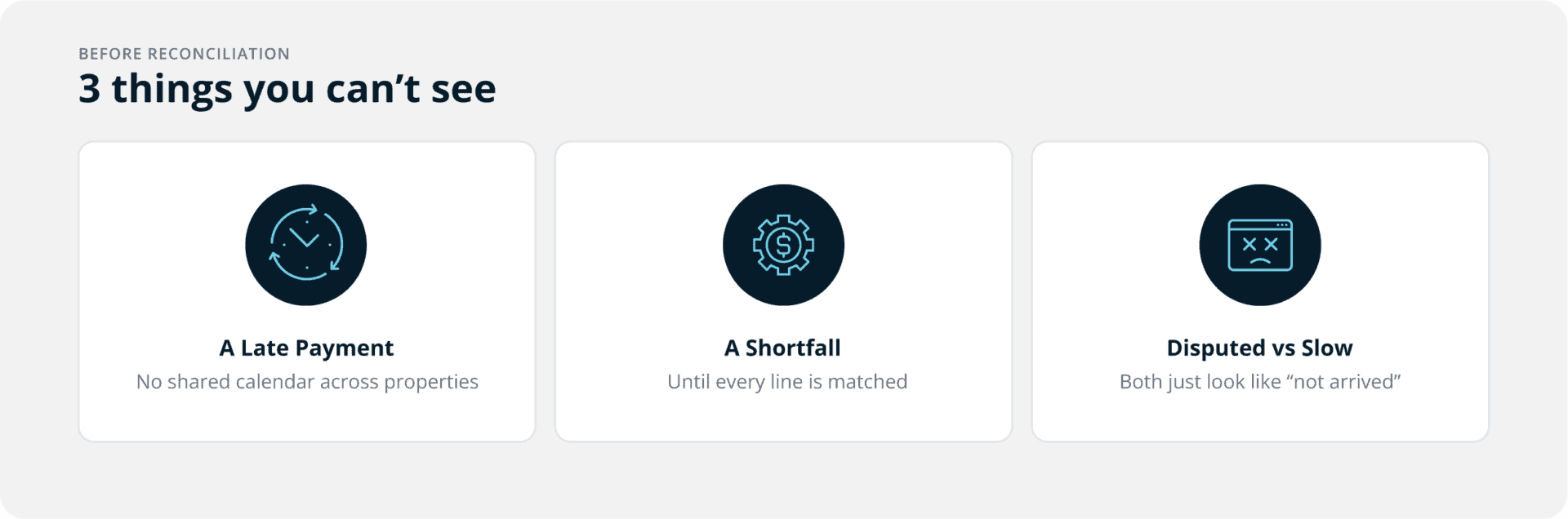
You can’t see a late payment until you go looking for it.
Some chains manage commission payments centrally and consistently. But a TMC’s bookings span many chains, brands, and independent properties, and payment timing varies across them: some pay within days of checkout, others batch payments monthly or quarterly. With no shared calendar across all those payers, a TMC has no way to flag a missed cycle the moment it’s missed. The gap only surfaces when someone manually checks, which usually happens at month-end close, by which point the payment could be weeks overdue.
You can’t see a shortfall until you’ve matched every line.
A remittance tells you what was paid. It doesn’t tell you whether that figure matches what was booked. Finding a discrepancy means comparing the two side by side, line by line, across every statement received that period. Skip a comparison because volume is high that month, and an underpayment simply doesn’t get caught, because nobody checked.
You can’t see whether something’s disputed or just slow.
A commission that hasn’t landed could be delayed, miscalculated, or actively contested. From the TMC side, all three look identical: money that hasn’t arrived yet. Telling them apart means picking up the phone or sending an email to the relevant finance team and waiting for a reply, which is exactly the back-and-forth that eats a back-office team’s week.
All three blind spots trace back to the same root cause: there’s no single, standardized view of commission status that spans every chain and property a TMC, books. Even where individual hotel companies run tight processes, formats, schedules, and remittance details differ from one payer to the next, so the agency receiving the money is also the one stitching the picture together after the fact.
That’s not a failure of any individual finance team or hotel company. It’s what happens when many separate payment streams all feed into one desk with no shared view across them. It’s also why the fix isn’t “hire more people to reconcile faster.” Adding headcount to a process that’s blind by design just means more people looking for the same gaps a little sooner.
The actual fix is structural: a shared, standardized view of commission status that updates as payments move, rather than one that gets rebuilt from scratch every month from whatever format each payer happened to send.
That’s the approach Onyx CenterSource takes with SurePay. It consolidates commission data from participating hotels in more than 160 countries into a single report and a single payment, so status is visible as it changes. If any of the three blind spots above sound familiar, it’s worth a look: onyxcentersource.com/solutions/travel-commission-payments/
For organizations looking to take that a step further, Onyx’s reconciliation services can help manage that process on their behalf. If any of the three blind spots above sound familiar, it may be time to look at how a more streamlined approach to commission payments and reconciliation can help.