
In-person meetings never really needed a comeback story anymore – they’re just how the industry works now. The conversation has moved from “will people show up” to “what will make them stay engaged, and what will it cost to get them there.” Eighty-five percent of meeting professionals say they’re optimistic about the state of meetings and events in 2026, per Amex GBT’s 2026 forecast, even as budgets stay tight and planners get more selective about where the money goes.
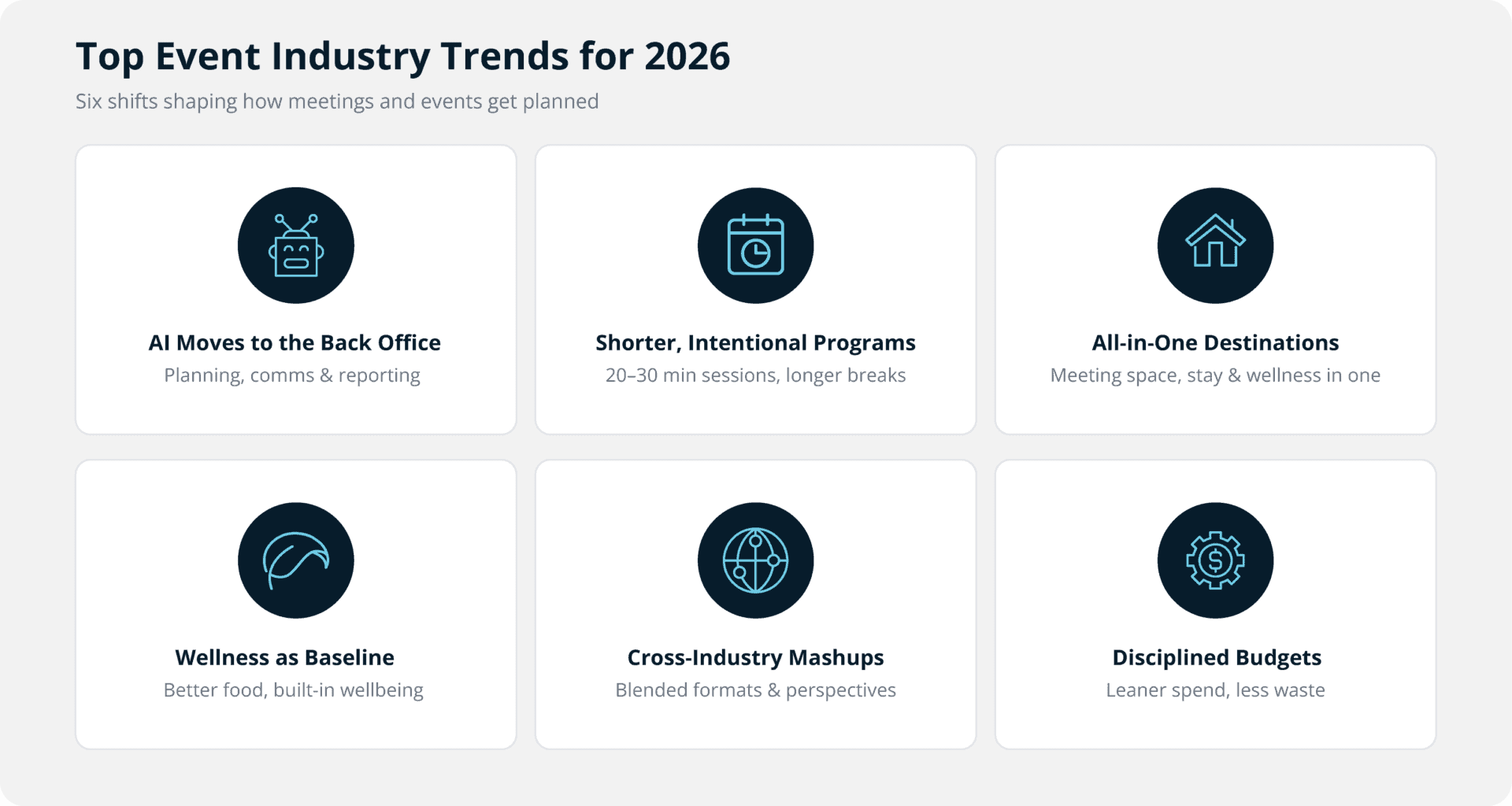
That mix – optimism plus caution — is shaping how events get built this year. Planners are cutting the parts that don’t earn their keep (fewer giveaways, shorter agendas, leaner staffing) and doubling down on the parts attendees actually remember. Here’s what’s driving event strategy for 2026.
AI Moves From Novelty to Back-Office Tool
Event tech coverage used to mean AR headsets and immersive booths. In 2026, the AI conversation is quieter and more operational. Twenty-eight percent of planners say AI adoption is a top trend shaping their priorities this year, and 84% expect it to have a moderate-to-major impact on the industry, according to Cvent’s 2026 Planner Sourcing Report. Most of that impact isn’t attendee-facing, it’s in planning, attendee communications, and post-event reporting, where 66% of event professionals say AI frees them up for higher-value work.
For planners, that means less time spent reconciling spreadsheets and chasing approvals, and more time on the parts of the job that actually require judgment: room flow, program design, partner relationships.
Shorter, More Intentional Programming
The 90-minute keynote is on its way out. Corporate planners are seeing better engagement from 20- to 30-minute sessions paired with longer breaks built for actual conversation, and attendees are responding to programs that leave room to explore rather than sit through a fixed agenda start to finish. Hilton’s 2026 Trends Report ties this to what it calls the “whycation” – attendees increasingly asking why they’re gathering before they decide how, and expecting the format to match the reason.
Practically, this shows up as flexible layouts, natural light, comfortable seating built for conversation rather than note-taking, and agendas that trade volume of content for depth of connection.
Venues Built for More Than the Meeting Room
Nontraditional venues are still doing the work they were doing a few years ago, but the ask has evolved. Planners are now looking for destinations that combine meeting space, accommodations, dining, wellness, and on-site entertainment in one property, so attendees don’t have to leave the experience to get any of it. It’s less about a striking backdrop for a single photo and more about a venue that can carry an entire multi-day agenda without attendees needing to go elsewhere.
Wellness and Wellbeing, Reframed
Meditation breaks and step challenges haven’t gone away, but the framing has shifted from “wellness add-on” to baseline expectation. That shows up in the food, too. More inclusive menus are the defining trends for 2026, alongside the ongoing move away from sugar-heavy catering toward food that keeps people alert through an afternoon session.
Cross-Industry Collaboration
A newer thread for 2026: planners deliberately mixing perspectives, formats, and even industries within a single event, rather than keeping programs siloed by discipline. The logic is straightforward – attendees who’d never cross paths in their usual conference circuit bring ideas to each other that a single-track agenda can’t produce on its own.
Budgets Stay Disciplined
None of the above changes the fact that 2026 is a cost-conscious year. Maritz’s September 2025 Industry Trends report puts expected cost increases for hotels, airfare, food and beverage, and event staffing at 2 to 4 percent, in line with general inflation, not above it. Where organizations are cutting, it’s food and beverage spend, staffing, giveaways, and session count, not the meetings themselves.
That combination – steady optimism, tighter budgets, and less patience for anything that doesn’t earn attendee attention is exactly why the back-office side of event planning matters more this year, not less. When there’s less room in the budget for waste, commission delays and reconciliation errors cost more than they used to.
The Part That Shouldn’t Take Up Your Time
Every trend above is about what happens at the event. None of it should be competing for a planner’s attention with commission tracking, disputed payouts, or an unreconciled invoice from three months ago. GroupPay powered by Onyx CenterSource automates group commission processing and payment so hotels and meeting professionals can see where every commission stands without opening a spreadsheet.
If 2026 is the year of leaner budgets and higher expectations, the events that come out ahead will be the ones where the team spent its time on the program, not on the paperwork behind it. Learn more about GroupPay.